Nudges Are Designed for Eyes. What Happens When the Buyer Has None?
Twenty years of behavioural economics went into the modern checkout: countdown timers, scarcity badges, anchored prices. All of it assumes a human is looking at the screen. AI shopping agents are breaking that assumption.
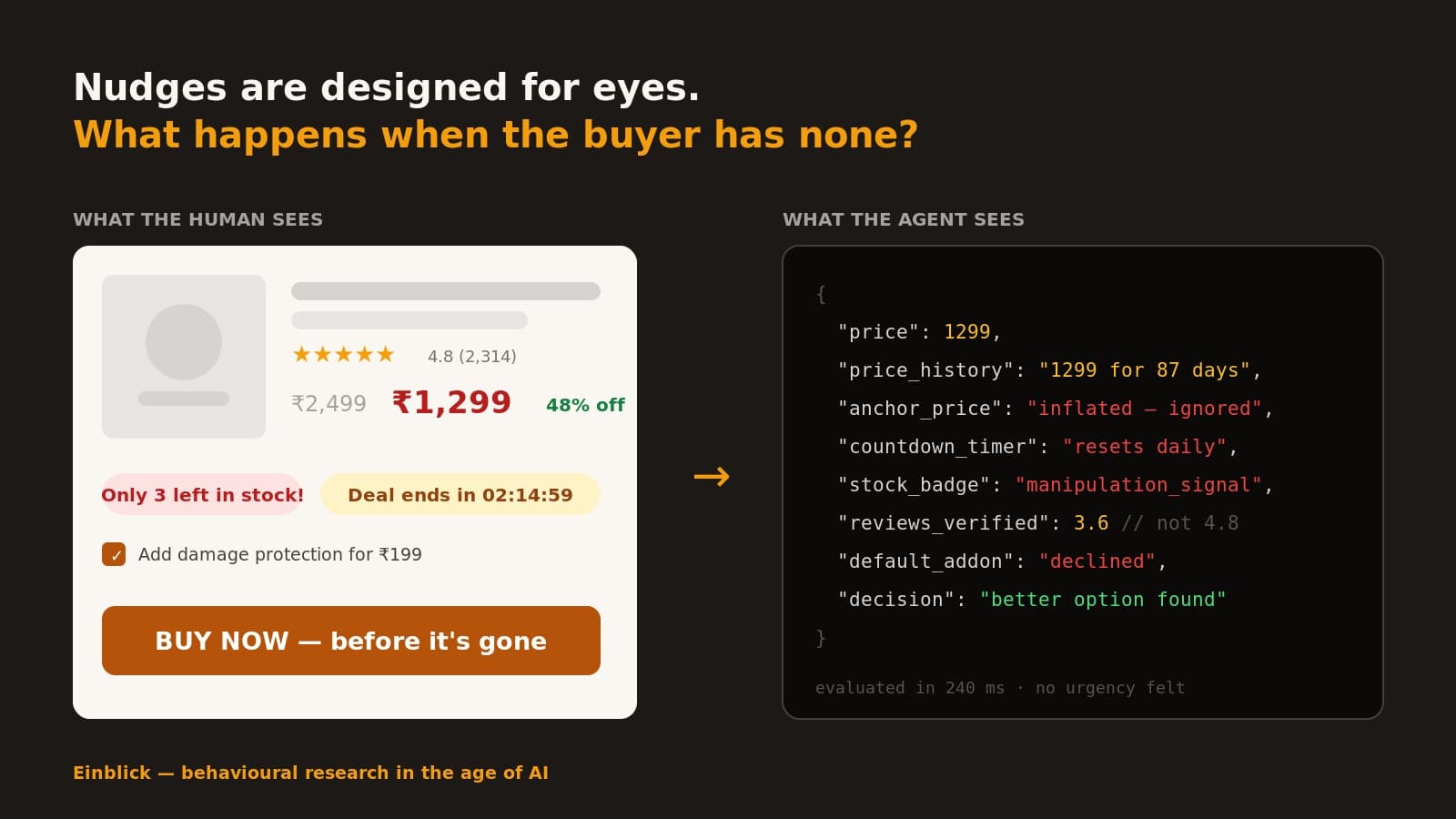
Walk through any e-commerce checkout and you are walking through a museum of applied behavioural economics.
The countdown timer manufacturing urgency. The "only 3 left in stock" badge triggering scarcity. The original price crossed out next to the deal, a textbook anchor. The default-ticked add-on insurance. The reviews sorted so the five-star ones greet you first. None of this is accidental. It is twenty years of Kahneman, Thaler, and Cialdini translated into pixels and A/B tested on millions of us.
All of it shares one design assumption so obvious that nobody ever states it: a human is looking at the screen.
That assumption is now breaking.
The eyes are leaving the storefront
AI shopping agents have moved from demo to reality faster than most retailers expected. ChatGPT, Gemini, and Perplexity now research products, compare options, and in some flows complete purchases on the user's behalf. Google and OpenAI are racing to build competing commerce protocols[1] so that merchants can sell directly to agents.
Closer to home, Swiggy built an integration[4][5] that lets users order food and groceries through ChatGPT, Claude, or Gemini without ever opening the Swiggy app. BigBasket piloted grocery purchases inside ChatGPT, and Flipkart, AJIO, and FirstCry are reportedly building AI storefronts of their own.
The direction is clear. An increasing share of purchase decisions will be made, or at least shortlisted, by software that has no eyes to nudge.
What breaks
An agent parsing a product page does not feel urgency. The countdown timer is just a div element. "Only 3 left" is a string it may ignore, or worse for the merchant, flag as a manipulation signal. Anchored pricing does not work on a system that can check the actual price history in milliseconds. Social proof carries no warmth when the reader is a model weighing structured review data.
The dark-patterns industry, and much of what we politely call conversion rate optimisation, was built to exploit System 1: fast, emotional, heuristic-driven thinking. An AI agent is, in a crude sense, all System 2. The nudge toolkit does not just weaken. Aimed at an agent, most of it simply misses.
If this were the whole story, agentic commerce would be a consumer-protection dream: a rational buyer, immune to manipulation, acting purely on our instructions.
I do not believe that is the whole story.
Persuasion does not die. It relocates.
The agent has to get its recommendations from somewhere. Which products get retrieved, how they are ranked, what the model considers a good match: that is the new shelf, and the fight for it has already started. Merchants are beginning to optimise product data not for human browsing but for machine legibility, and platforms are signing commerce partnerships that shape what agents surface. The persuasion is moving upstream, away from the storefront, where regulators and users could at least see the dark pattern, into ranking and retrieval layers where nobody can.
And we, the humans, do not become rational just because our agent is. We bring a fresh set of biases to the new layer.
Automation bias. We over-trust the machine's pick, questioning an agent's recommendation far less than a salesperson's.
Default effects. The assistant bundled into our phone or chat app becomes the agent we never think to switch.
Single-source dependence. Where we once compared three sites, we may soon ask one model and accept its answer.
The early evidence is behavioural, not technical
Here is my favourite signal so far. OpenAI launched Instant Checkout inside ChatGPT with real merchants and real payments, and wound it down within months.[6] Why? Shoppers were happy to let ChatGPT research and compare, but they preferred to complete the purchase where their accounts and saved payment methods already lived.
The same pattern shows up in India: Swiggy's AI-channel orders launched with cash on delivery as the only payment option.
Read that as a behavioural finding: delegation of research came easily; delegation of trust did not. People handed the agent their curiosity but not their wallet. Anyone who has studied how consumers actually adopt technology, as opposed to how roadmaps say they will, will find this pattern familiar.
The questions I am sitting with
I do not have answers yet, and I am not sure anyone does. But these are the questions I will be exploring in the coming weeks.
If the agent decides the shortlist, who is the nudge aimed at, the human or the model?
Does choice architecture become model architecture? And if persuasion moves inside the model, who audits it?
What happens to brand loyalty when the loyal party is software that can be re-instructed in one sentence?
And the one closest to my own work: when the model becomes the shelf, how does anyone do market research?
References
- [1]OpenAI, Buy it in ChatGPT: Instant Checkout and the Agentic Commerce Protocol
- [2]Adobe, AI-driven traffic surges across industries; retail sees biggest gains
- [3]Adobe Analytics, Traffic to US retail sites from generative AI sources jumps 1,200%
- [4]Business Standard, Swiggy enables grocery and food delivery via ChatGPT and other AI tools
- [5]YourStory, Swiggy lets users order through ChatGPT, Claude, Gemini
- [6]CNBC, OpenAI's first try at agentic shopping stumbled. It's trying again