Why Market Research in India Is Broken (and Nobody's Talking About It)
Surveys say Indians will buy electric cars and pay extra for eco-friendly products. Reality says the opposite. The problem isn't the people, it's the data.
Imagine you survey 1,000 people in India and ask how much they love ten different car brands. The results come back, and every brand scores almost exactly the same, around 9 out of 10. The most loved brand and the one nobody likes look identical.
That's not a result. That's a warning sign.
A survey is supposed to find differences. When it tells you everything is the same, it usually means the people answering weren't really paying attention, or weren't real people at all.
Surveys say one thing. The market does another.
Take electric cars. For years, global studies have ranked Indians among the most excited EV buyers in the world. If that were true, the roads would be full of them.
They're not.
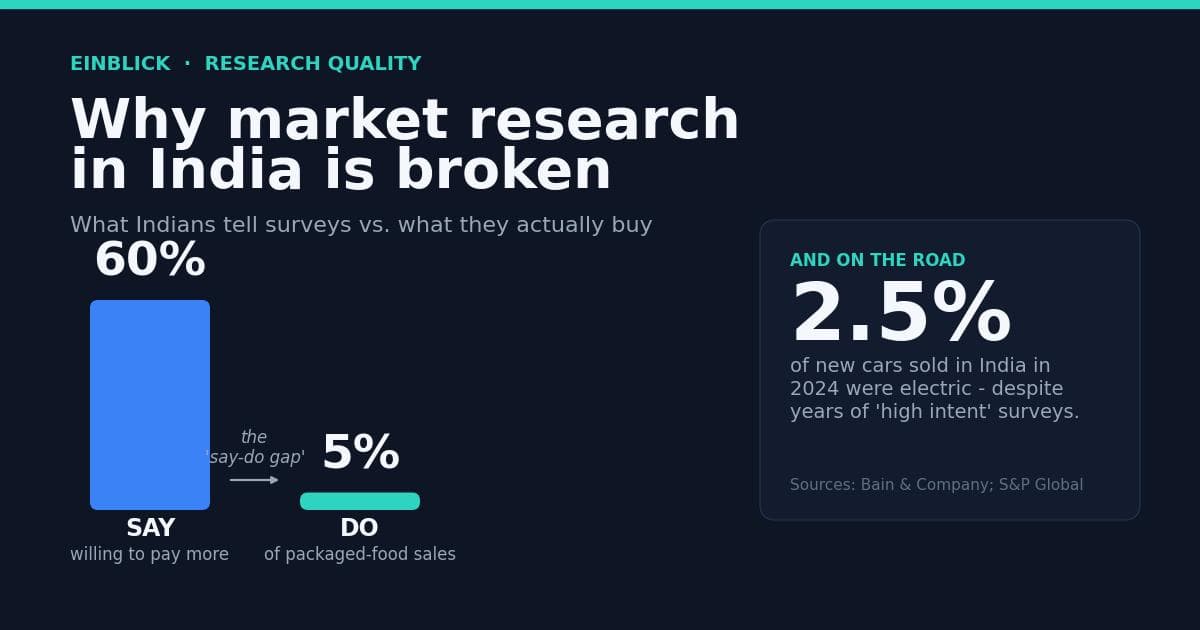
That number climbed to only about 3.5% in early 2025-26,[1][2] one of the lowest rates of any big market. The excitement in the surveys never showed up in real life.
Now a completely different example. A Bain and Company survey found that about 60% of Indian consumers say they're willing to pay a premium for sustainable products,[3] and that Indians will accept the highest premium in the world, around 20% extra,[4] more than shoppers in the US or Europe.
Yet by Bain's own measure, sustainable products make up just 5% of the packaged-foods market in India.[3] So 60% say they would pay more, but sustainable products are only 5% of what actually sells. Bain calls this gap between what people say and what they buy the "say-do gap."
The survey captured what people felt good saying, not what they did at the store.
Why does this keep happening?
No single cause explains it, and we're not claiming every survey is fake. But a handful of factors likely carry most of the weight.
Fake and fraudulent respondents. Bot farms and professional survey-takers fill out surveys for money, and they've gotten good enough to slip past the basic checks most panels use.[5]
Bored, rushed answering. When someone is just clicking through for a reward, the easiest thing to do is agree with everything and give every question the same score. Researchers call it "straight-lining."[6] It quietly flattens the real differences.
The wrong people. Most Indian online panels lean metro, English-speaking, well-off and younger, a thin slice of a 1.4 billion person country, and rarely verify who is really answering. The fast-growing India of Tier 2 and Tier 3 towns is barely heard from.
How much each factor contributes will vary from study to study, and measuring that share instead of guessing it is exactly what a good quality system should do. But the direction is consistent, and there's a telling clue: on higher-quality panels, these distortions can shrink sharply or disappear,[6] which suggests the bad answers were never really about consumers. They came from inattentive or fake respondents on weak panels.
Why it matters
This bad data doesn't look bad. It looks confident. It goes into a slide. A company uses it to decide which product to launch or how to position a brand, decisions worth crores. And when the launch flops, nobody blames the survey that started it.
What we're building
Einblick exists because we believe this is fixable, and we're treating it as a craft, not a one-time fix.
We start with the foundation every honest study needs: verified respondents (real, identity-checked people from across India) and an AI layer that scores every answer for whether it came from a genuine, engaged human, so the good data is kept and the junk is thrown out. But that's the starting line, not the finish. We treat quality as an ongoing discipline: continuously testing our methods against real-world outcomes, learning where data goes wrong, and refining (and inventing) new techniques as the research demands. The aim is a system that keeps getting better at telling signal from noise.
We're not anti-AI, and we're not against synthetic data. We build synthetic respondents too: AI-simulated audiences that let teams explore ideas quickly and cheaply. The difference is that we keep a hard, transparent line between what is genuine human data and what is synthetic, and we calibrate our synthetic models against our verified humans so they stay honest. Synthetic for speed and early iteration; verified humans for the decisions that actually matter. As AI-generated answers spread across the industry, they only stay accurate if they're checked against real, verified human data,[7] so the value of trustworthy human voices goes up, not down.
And we're deliberately built to hear from the India most panels ignore. The country's next wave of consumer growth is coming from Tier 2 and Tier 3 towns, not just the metros that dominate today's online panels. Reaching those voices, in their languages, with verified identities, is exactly where we focus. That's our stronghold.
References
- [1]S&P Global, India's EV Market: Trends and Future Prospects
- [2]EVreporter, India EV Report FY24-25
- [3]Bain & Company / Indian Retailer, 60% in India willing to pay a premium; sustainable products about 5% of packaged foods
- [4]Bain & Company / ESG Today, Consumers willing to pay a premium for sustainable products (India about 20%)
- [5]Dynata, The Authenticity Crisis
- [6]Cambridge / Political Analysis, Survey Quality and Acquiescence Bias: A Cautionary Tale
- [7]arXiv, Synthetic Data and the Shifting Ground of Truth